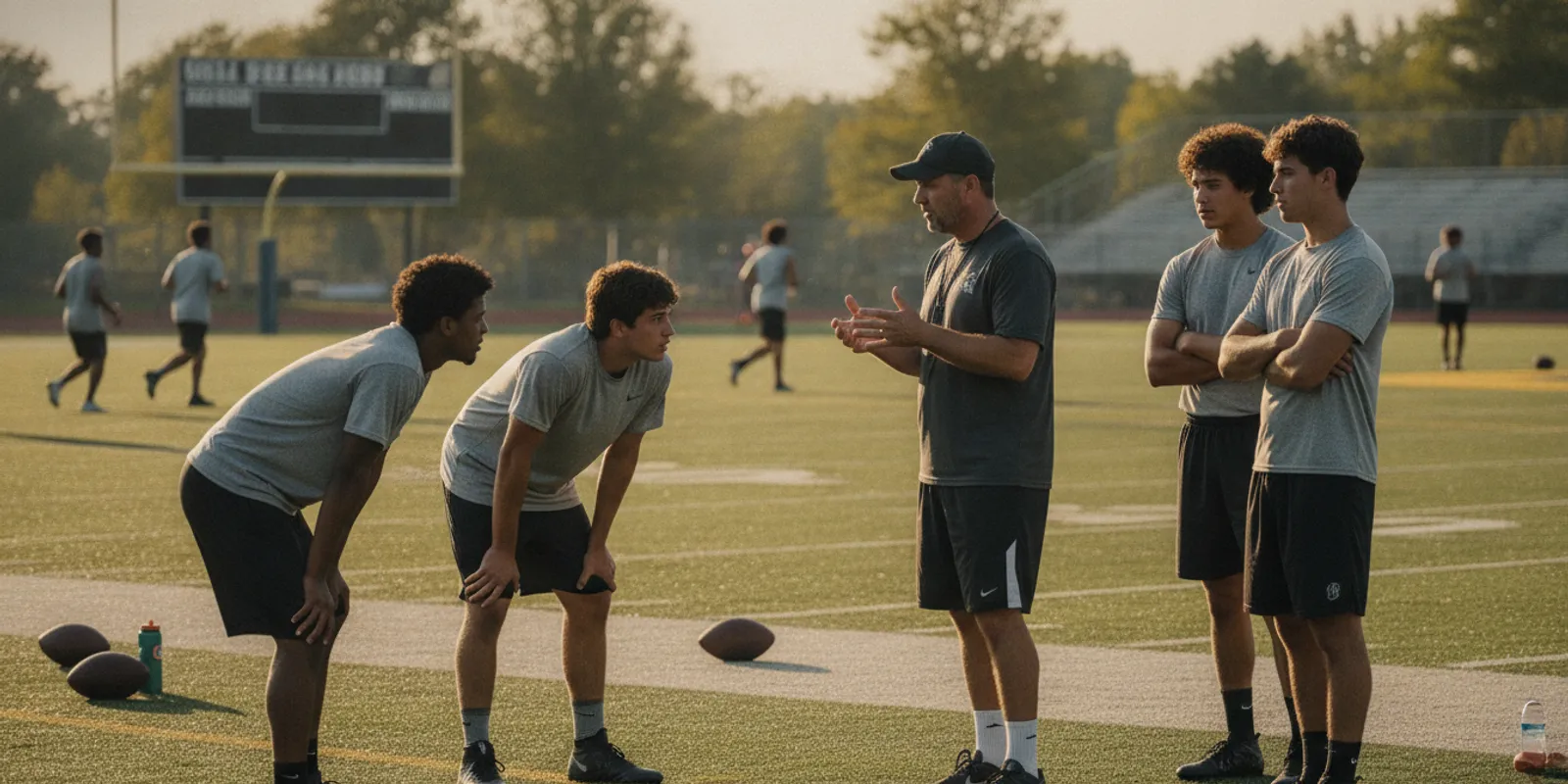
Mental toughness training for coaches is a form of leadership development: it helps athletes respond to pressure with repeatable skills, not by hiding difficulty or simply trying harder. A strong approach builds coping strategies, clear communication, reflection, and routines that athletes can use in practice and competition. Coaches can develop those skills through short, regular exercises tied to real moments in the sport.
Connect with Aaron to discuss your team
What should mental toughness training help athletes do?
Mental toughness is often treated as a personality trait: some athletes have it, and others do not. That framing gives coaches little to teach. A more practical view asks what an athlete can do when a plan changes, a mistake happens, or the stakes rise.
For a coach, the goal is not to eliminate nerves or disappointment. It is to help athletes notice what is happening, choose a useful next action, and stay connected to their teammates and the task. That takes practice. It also means making room for athletes to speak honestly about pressure instead of rewarding silence as proof of strength.
Useful skills include:
- Attention control: returning focus to the next assignment after distraction.
- Emotional regulation: noticing frustration or anxiety and selecting a response that helps rather than harms performance.
- Flexible thinking: adjusting when the original plan is no longer available.
- Communication: asking for clarification, giving concise information, and receiving feedback.
- Recovery after setbacks: reviewing what happened, learning from it, and re-engaging.
These are behaviors a team can name, rehearse, and revisit. They fit within broader speaking and consulting support for different industries when an organization wants to connect a team session to its specific context.
Why does practice matter more than a speech about toughness?
A message can create a shared starting point, but a single talk cannot substitute for repeated practice. Athletes need low-risk opportunities to try a response, get feedback, and use it again when pressure increases. The training should not promise that a technique will remove stress. It should help the athlete have a next step when stress is present.
A review of mental toughness research describes mental skills such as coping strategies, imagery, and relaxation as approaches coaches attempt to build. See this overview of mental toughness and athletic success. For coaches, the practical question is how to introduce a skill, use it in context, and evaluate whether it helps athletes execute.
Training can be simple. Before a demanding drill, ask athletes to identify one controllable cue. Afterward, invite them to describe whether the cue helped and what they will try next. Over time, that sequence (prepare, perform, reflect) can become part of normal practice rather than a special event.
Which mental skills can coaches teach and rehearse?
Use a reset routine after mistakes
Help athletes build a short routine they can use after an error. For example: pause, take one steady breath, name the next assignment, and communicate with a teammate if needed. The exact routine should fit the sport and athlete. The value is its simplicity: under pressure, a familiar sequence can be easier to recall than a long motivational speech.
Practice the routine during ordinary drills. If a player misses a pass or loses position, avoid turning every error into a public lecture. Give a clear cue, let the athlete reset, and return attention to the next rep. Later, discuss what worked and what needs adjusting.
Rehearse coping strategies before the high-stakes moment
Ask athletes to anticipate a difficult situation: a close score, a long delay, a mistake early in a game, or an unexpected role change. Have each person identify a response they can control. One athlete may use a breathing pattern; another may focus on a technical cue or ask a teammate for a reminder.
Keep the conversation grounded. "Stay positive" is too vague to guide action. "After a turnover, get back on defense and call out the matchup" gives the athlete an observable next step. Coaches can ask athletes to explain the cue in their own words so it feels usable, not imposed.
Use imagery and scenario practice thoughtfully
Imagery can help athletes mentally rehearse a familiar action or response. Invite them to picture a specific situation, including what they will see, hear, and do. Keep it brief and connected to an actual skill. For example, a team might rehearse how it will communicate when an opponent changes tactics.
Scenario practice should challenge athletes without humiliating them. Explain the purpose, make the drill relevant, and debrief afterward. A useful debrief asks: What did you notice? What helped you respond? What would you change next time?
Teach athletes to ask for and use feedback
Mental toughness does not mean refusing help. Athletes benefit from learning how to ask a focused question, listen to an answer, and test an adjustment. Coaches can model this by giving feedback that is specific and actionable: identify the behavior, explain its effect, and state the next cue.
For instance, instead of "You need more focus," a coach could say, "Before the next play, check the signal and repeat the assignment to your partner." The athlete knows what to do. When the athlete improves, acknowledge the action and reinforce the process.
How can coaches build leadership development into practice?
There is no need to add a separate hour-long session to every practice. A coach can weave mental skills into existing routines. Start with one skill, make its use visible, and review it consistently.
- Choose a specific pressure point. Identify a recurring situation such as recovering after mistakes or communicating during a fast transition.
- Define the behavior. Describe what athletes should do in observable terms. Avoid broad labels like "be tougher."
- Teach one tool. Demonstrate a reset, cue, coping strategy, or communication sequence.
- Rehearse it in a relevant drill. Begin with manageable difficulty, then vary the situation as athletes become familiar with the skill.
- Debrief briefly. Ask what was effective and what the team will repeat or adjust.
- Return to it later. Revisit the same skill in another practice and notice whether athletes can use it with less prompting.
A coach might focus on response after mistakes for two weeks. During the first practice, players agree on a short reset routine. In later drills, the coach uses a consistent cue after errors. At the end of each week, athletes share which part they remembered and what made it difficult. This is not a guarantee of improved results. It is a structured way to make the skill teachable and observable.
Make the progression deliberate. Start with a predictable drill where athletes can concentrate on the routine without also learning a new technical skill. Once they can describe and perform the reset, add a modest complication: a time limit, a change in the sequence, or a teammate communication requirement. After each variation, ask what stayed useful and what had to change. Difficulty should rise because the skill is becoming familiar, not because the coach wants to catch someone out.
Consider a basketball practice focused on communication after a defensive breakdown. First, establish a concise shared call for the next assignment. Then run a controlled two-on-two situation and pause after each rep to check whether players heard and acted on the call. Later, play through several possessions without stopping, then debrief. This progression lets a coach distinguish a problem with understanding from a problem with execution under speed. It also gives athletes a concrete behavior to improve instead of a vague instruction to "communicate more."
What does a useful team debrief sound like?
Debriefs turn experience into learning, but they work best when they are focused and respectful. A coach can use three questions:
- What happened, without blame or exaggeration?
- What response helped us stay with the task?
- What is one adjustment we will test next time?
Give athletes a moment to think before inviting responses. Not every player will want to speak in front of the whole group. Offer a written reflection or a conversation in pairs when that suits the team better. The aim is to surface useful information, not to force disclosure.
Leaders also need to examine their own habits. If a coach says mistakes are part of learning but reacts to every error with sarcasm, athletes receive conflicting signals. Consistency between the stated standard and the coach's response matters. Teams can discuss how to correct one another while preserving clear expectations and respect.
A debrief can be brief and still specific. Ask an athlete to name the cue they used, not simply whether the drill felt good. Ask the group which information arrived in time to help a teammate. If an answer reveals that the cue was unclear, rewrite it together and try another repetition. That turns reflection into a bridge back to action. It also avoids making the debrief a verdict on who is mentally strong; the focus remains on what the team can learn and practice.
How should coaches adapt training to different athletes?
A team is not made up of identical people. Athletes differ in experience, communication preferences, roles, and the kinds of pressure they face. One reset routine may not work for everyone. Teach a shared framework, then let athletes adapt the details with appropriate guidance.
Make participation clear and accessible. Explain activities before they begin, offer more than one way to contribute, and check that instructions are understood. If an exercise includes visualization, for example, athletes can also work with a spoken cue or a written sequence. The purpose is to build a useful skill, not to test whether someone learns in one particular way.
Coaches should also distinguish ordinary performance pressure from concerns that need support beyond team training. A coach can listen, respond with care, and connect an athlete with the appropriate school, club, or health professional resources. Mental skills practice is not a replacement for professional care.
Adaptation also applies to age and experience. A younger athlete may need a coach to model the routine aloud and prompt it during a drill. An experienced athlete may prefer to choose a personal cue and review it independently. In either case, agree on what the skill looks like before pressure rises. If athletes share a team language but can use it in a way that fits them, a routine is more likely to feel like a tool than a script imposed from the sideline.
How can a program tell whether the training is useful?
Use evidence that coaches and athletes can actually observe. Before a session begins, identify the behavior you hope to see more consistently. Then check for it during practice and invite athletes to reflect on whether the tool feels practical.
| Training focus | Practice activity | What to observe |
|---|---|---|
| Reset after an error. | Rehearse a short routine during skill drills. | The athlete returns attention to the next assignment. |
| Communication under pressure. | Run a scenario that requires concise teammate cues. | Players share relevant information and confirm responsibilities. |
| Coping with uncertainty. | Introduce a planned change to a familiar drill. | Athletes identify controllable next actions. |
| Learning from experience. | Hold a brief, structured debrief. | The team names a lesson and a specific adjustment. |
These observations are not a ranking of character. They are prompts for coaching. If an athlete struggles to use a routine, ask whether it was clear, practiced enough, or suited to the moment. Adjust the training rather than assuming the athlete lacks commitment.
Choose only a few indicators at a time. A coach might note whether athletes use the agreed reset cue, whether teammates respond to a call, and whether the post-drill review identifies an actionable adjustment. Keep the observation period consistent, such as a set of practices devoted to one skill. A simple record of what happened can help a staff notice patterns. Athletes may remember the routine in a slow drill but lose it when roles change. The cue may also work for some positions and need a different version for others.
Invite athletes to assess usefulness alongside the coach's observations. Ask whether the routine is easy to remember, whether it fits the sport, and what gets in the way of using it. Do not treat self-report as a score of toughness. Use it as context for improving instruction. If the group reports that a reset routine feels too long, shorten it; if a communication phrase creates confusion, replace it and rehearse the new wording. Reviewing the training itself keeps accountability shared.
What role can a speaker or facilitator play?
A speaker or facilitator can help a team name shared challenges, explore practical strategies, and practice a common language. The strongest fit depends on what the program needs: a keynote to establish a theme, an interactive workshop to rehearse skills, or follow-up support to connect learning to daily behavior.
Aaron Golub draws on his experience as a Tulane football player and team captain, and as the first legally blind Division I athlete to play in a game. His work connects adversity with practical approaches to leadership, communication, and performance. For a coach or organizer evaluating formats, consider whether the session allows participants to engage actively and whether its takeaways match the team's real pressure points. Explore speaking focused on achieving success through adversity and in-person and virtual engagement options.
Before booking, clarify the audience, the outcome you want participants to work toward, and how the session will connect to practice afterward. Aaron's engagements are tailored to needs, format, and scope, so organizers can discuss the program with Aaron rather than assume a standard format.
To make an outside session useful, prepare the facilitator with the team's actual context. Share the age and experience range, sport, recurring pressure points, and the language already used by the coaching staff. Ask how participants will practice or discuss the ideas, what materials or follow-up are needed, and how the session can complement existing routines. This helps keep the message relevant rather than generic. A well-matched session should leave coaches with a small number of skills they can reinforce, not a long list of slogans that disappears once practice resumes.
For a school or athletic department, also clarify who will reinforce the learning after the event. A coach might choose one routine to revisit at the next practice; a program leader might coordinate the same language across several teams. The goal is not to make every athlete respond identically. It is to make the core expectations clear and give each group a practical way to revisit them.
Schedule a conversation about your team
Frequently asked questions
How often should a team practice mental skills?
Build short repetitions into regular practice and return to the same skill over time. Frequency depends on the team schedule and the skill being taught; consistency is more useful than a one-time activity.
Does mental toughness mean ignoring stress?
No. It means learning ways to notice pressure, respond constructively, and stay connected to the task and teammates. Athletes should be able to ask for support when they need it.
Can coaches teach these skills without a specialist?
Coaches can reinforce everyday habits such as clear cues, reflection, and reset routines. A qualified facilitator may help when a program wants a structured session or support tailored to a specific team goal.
How can a coach avoid making pressure worse?
Set clear expectations, correct behavior without humiliation, and make it safe to ask questions. Practice challenging situations with purpose, then debrief what athletes learned.
Make mental toughness a team practice
Coaches do not need to demand that athletes become unshakeable. They can teach practical responses, rehearse them in context, and create a team culture where reflection and accountability work together. Start with one pressure point, choose one skill, and give athletes repeated chances to use it.