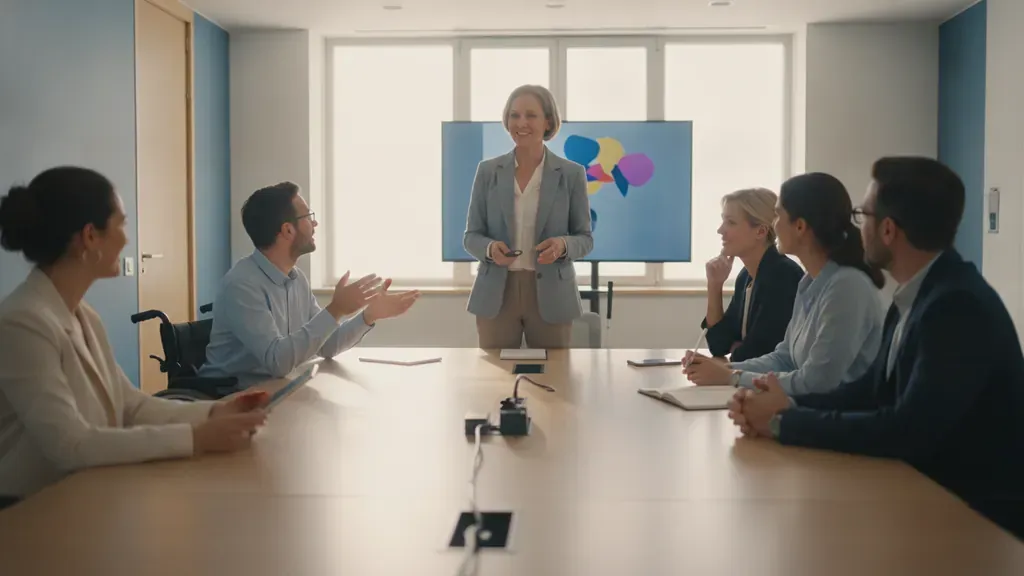
Disability inclusion in the workplace is not a side project for an awareness calendar. It is a leadership practice that shapes who can contribute, how teams solve problems, and whether people can do their best work. The strongest organizations move beyond good intentions and compliance checklists. They build work environments where access, belonging, accountability, and performance reinforce one another.
Want to make inclusion practical for your organization? Connect with Aaron to discuss a keynote, workshop, or consulting engagement built around your team's goals.
What is disability inclusion in the workplace?
Disability inclusion in the workplace means creating the conditions for people with disabilities to enter, participate, contribute, develop, and lead with equitable access to opportunity. It includes accessibility and reasonable accommodation, but it is broader than either one. It also includes the everyday behaviors, systems, communication habits, and leadership decisions that determine whether people feel able to bring their full capability to work.
A useful definition for leaders is this: disability inclusion is the deliberate removal of barriers so that people with disabilities can participate and perform as valued members of the organization, without having to carry the entire burden of making the workplace workable.
That definition has three important implications:
- It is designed, not assumed. A team can be welcoming and still have inaccessible meetings, unclear accommodation processes, or promotion practices that reward visibility rather than results.
- It is a shared responsibility. Human Resources, managers, executives, colleagues, IT, facilities, and event planners all influence access and belonging.
- It is measured by experience and outcomes. A policy on a website is not proof that employees can use it easily or trust the organization to respond well.
Inclusion does not mean lowering essential standards or treating every person identically. It means providing a fair opportunity to meet meaningful standards, while recognizing that people may need different tools, communication methods, or pathways to do so.
How disability inclusion in the workplace strengthens teams
Disability inclusion in the workplace is strongest when it changes how teams share information, solve problems, and make decisions. The goal is not to create a special track that separates disabled employees from the rest of the organization. It is to make access and participation part of the way the team works, while honoring individual needs and privacy.
When leaders provide clear context, accessible materials, flexible ways to contribute, and specific accountability, they reduce avoidable friction for many people. More importantly, they create a team culture where employees can raise a barrier before it becomes a performance or retention problem. That is a leadership practice, not a branding exercise.
Why disability inclusion is a leadership and performance issue
Leaders often inherit a false choice: either focus on performance or focus on inclusion. In practice, the two are connected. Teams lose time and talent when a capable person cannot access information, participate in a meeting, ask for support, or see a credible path to advancement. Leaders improve execution when they identify those friction points and address them deliberately.
Disability inclusion is also a test of leadership quality because it reveals how an organization handles difference, uncertainty, and shared responsibility. A leader who listens carefully, clarifies expectations, invites different ways of contributing, and follows through on commitments is building habits that strengthen the entire team.
Research should be interpreted responsibly. An organization does not earn better results simply by adding a statement about inclusion. The Accenture research on disability inclusion reported that companies identified as leaders in disability inclusion outperformed peers on several business measures. That is useful directional evidence, not a guarantee or proof that one initiative causes a particular financial outcome. The practical lesson is to build the conditions for better performance and then measure whether they are working.
A quantitative research review in the Journal of Occupational Rehabilitation likewise helps leaders think beyond slogans by examining organizational practices and outcomes for employees with disabilities. The exact result will vary by organization, industry, role, and implementation quality. The leadership question remains constant: what barriers are reducing contribution, and what system will remove them?
Compliance is the floor, not the finished workplace
Compliance matters. It protects rights and gives organizations a baseline for fair treatment. It does not, by itself, create a culture where people trust the process, managers know what to do, or teams make room for different ways of working.
The U.S. Equal Employment Opportunity Commission explains employer responsibilities under the ADA, including the prohibition on disability discrimination and the role of reasonable accommodation for qualified applicants and employees. The EEOC's reasonable accommodation guidance is an important legal resource. This article is not legal advice, and organizations should consult qualified counsel or appropriate specialists about their obligations.
For leadership purposes, the distinction is simple:
| Compliance asks | Inclusion asks |
|---|---|
| Are the required policies and procedures in place? | Can employees find, understand, and use the process without unnecessary friction? |
| Did we meet the minimum accessibility requirement? | Can people participate fully in the real meeting, workflow, event, or customer interaction? |
| Did we respond after someone reported a barrier? | Do we learn from barriers and prevent the same problem from recurring? |
| Did we hire someone with a disability? | Are people with disabilities able to develop, advance, influence decisions, and lead? |
| Did we deliver an awareness presentation? | Did behavior, systems, and accountability change after the presentation? |
Compliance protects the organization from ignoring rights. Inclusion helps the organization make better use of the people it has invited to contribute. High-performing leaders respect both responsibilities and do not confuse one with the other.
Aaron Golub's five-part framework for practical inclusion
Aaron Golub approaches inclusion through the lens of leadership, adversity, and performance. His perspective is grounded in lived experience and in the practical demands of helping teams change how they work. Aaron was the first legally blind Division I athlete to play in a game, competing for Tulane and serving as a team captain. That achievement is not a feel-good anecdote to place at the beginning of a presentation and then leave behind. It offers a useful leadership question: what systems, relationships, and decisions allow people to perform when the obvious path was not designed for them?
The framework below turns that question into five connected moves. They are not a replacement for legal guidance or a complete accessibility audit. They are a way for leaders to move from intention to action.
1. Listen before you design
Many inclusion efforts begin with a solution chosen before the people affected have been heard. A leader announces a new event, training, or policy and assumes the work is complete. A better starting point is disciplined listening.
Ask employees with disabilities, managers, candidates, and allies where work becomes harder than it needs to be. Look at the full employee experience rather than asking only whether someone received an accommodation. Important questions include:
- Where do candidates encounter friction before they can demonstrate their qualifications?
- Which meetings, tools, documents, or physical spaces are difficult to access?
- How long does it take to get a problem acknowledged and resolved?
- Do managers know how to respond to an accommodation request without treating it as a disruption?
- Can employees raise a barrier without being labeled difficult, fragile, or less committed?
- What happens to development and promotion when a person works or communicates differently from the majority?
Listening requires more than a one-time survey. Use confidential channels, structured interviews, employee resource groups, accessibility testing, manager feedback, and post-event reviews. Compensate external advisors or speakers for their expertise rather than expecting unpaid emotional labor from employees.
Do not ask one person to represent every disability. Disability is not a single experience, and visible and non-visible disabilities can create different barriers. The purpose of listening is not to collect a perfect list of diagnoses. It is to understand the work conditions that either enable or restrict contribution.
2. Design access into the work
After listening, redesign the points where people get blocked. This is where inclusion becomes operational. Review the systems that shape participation: recruiting, onboarding, meetings, technology, facilities, travel, training, performance management, and promotion.
Good design reduces the need for people to repeatedly explain why a basic access feature matters. Examples may include:
- Providing agendas, materials, and questions in advance when that improves participation.
- Using accessible documents, meaningful headings, descriptive links, captions, transcripts, and image alt text where appropriate.
- Making virtual and in-person meetings work together rather than treating remote participants as an afterthought.
- Offering multiple ways to contribute, such as speaking, chat, written follow-up, or smaller-group discussion.
- Making the accommodation process clear, confidential, timely, and easy to locate.
- Checking physical routes, room layouts, lighting, sound, seating, and emergency procedures before an event.
- Testing recruiting and collaboration technology with users who rely on assistive technology.
Universal design and individualized accommodation are complementary. A captioned, well-structured presentation helps many people, while a particular employee may still need an individualized adjustment. Leaders should not make a person prove that a general improvement benefits everyone before acting on an individual need.
Design also means examining unwritten rules. Is the person who talks first assumed to be the most prepared? Is the employee who travels constantly given more visibility? Does a promotion require a style of networking or presentation that is unrelated to the essential work? Inclusive design makes the real job clearer and gives people more than one legitimate way to demonstrate value.
3. Lead inclusion through daily behavior
Policies do not enter a room by themselves. Managers and colleagues bring the culture into each interaction. A leader can make inclusion visible through small, repeatable behaviors:
- Ask about access needs privately and respectfully, without demanding medical details.
- Use the person's preferred language and identity terms rather than guessing.
- Describe visual information when it is needed for the discussion, and avoid making someone repeatedly request it.
- Pause long enough for people to process and respond instead of rewarding interruption.
- Make ownership clear when a barrier is reported. The employee should not have to chase five departments to get a response.
- Address disrespect, jokes, assumptions, and exclusion in the moment.
- Evaluate performance against agreed outcomes and essential responsibilities, not stereotypes about how commitment should look.
Inclusive leadership is not about avoiding honest feedback. It is about making feedback specific, accessible, and connected to the work. Leaders can hold high standards while asking whether the employee had a fair chance to understand the expectation, access the necessary information, and demonstrate the result.
Emotional intelligence matters here. A manager may feel uncertain about disability or worry about saying the wrong thing. That discomfort cannot become the employee's burden. The manager can acknowledge what they do not know, ask a respectful question, consult the right resource, and follow through. Curiosity paired with accountability is more useful than silence disguised as politeness.
4. Activate strengths across the team
Inclusion should not stop at removing obstacles. Leaders should also notice the capabilities, judgment, creativity, and resilience that people bring to complex work. This does not mean romanticizing disability or assuming that a disabled employee has a special gift in every situation. It means using the same discipline applied to any high-performing team: understand people's strengths, give them meaningful responsibility, and create conditions for them to grow.
A team can activate strengths by:
- Assigning work based on capability and development goals rather than assumptions.
- Inviting employees with different experiences into product, service, customer, and process decisions.
- Separating the essential result from a traditional method of reaching it.
- Building peer support and mentorship without making the employee a permanent educator for everyone else.
- Recognizing behind-the-scenes problem solving, not only the most visible presentation style.
- Creating promotion pathways that reward sustained contribution, judgment, collaboration, and results.
Disability inclusion can improve the way a team thinks about customers and users because it encourages leaders to notice assumptions in the design of a product, service, event, or communication. That benefit is strongest when employees with disabilities have real influence, not when they are invited only to validate a decision already made.
For leaders, this is a shift from accommodation as exception to access as a condition of contribution. The question changes from "How do we fit this person into our existing system?" to "What does the work require, and how can we design a fair path for capable people to do it?"
5. Measure performance and accountability
What gets measured gets discussed. What gets owned gets improved. A disability inclusion program needs measures that show whether access and belonging are becoming part of how the organization operates.
Use a balanced set of indicators rather than one headline number.
| Area | Questions to track |
|---|---|
| Access | Are priority websites, documents, tools, spaces, and events accessible? How quickly are barriers resolved? |
| Talent | Where do candidates and employees with disabilities enter, advance, pause, or leave the talent pipeline? |
| Manager capability | Do managers know how to respond, where to get help, and how to make meetings and feedback accessible? |
| Experience | Do employees feel safe raising an access need and confident that the organization will respond respectfully? |
| Performance | Are inclusive practices improving clarity, participation, collaboration, quality, retention, or time to resolution? |
| Accountability | Which leader owns each improvement, what is the deadline, and how will employees know what changed? |
Protect confidentiality. Small employee populations can make demographic data identifiable, and accommodation information is sensitive. Report patterns responsibly, limit access, and involve appropriate HR, legal, privacy, and employee representatives.
Do not claim that any change caused a financial result without a credible evaluation. Instead, establish a baseline, make a defined change, measure the relevant operational outcome, and gather qualitative feedback. For example, if leaders introduce accessible meeting practices, track participation, decision clarity, follow-up work, and employee experience over time. That produces a more useful learning loop than declaring success after one training session.
Need a leadership conversation that moves from awareness to action? Explore Aaron's keynote and workshop topics for practical programming on thinking differently about disabilities, leadership, resilience, emotional intelligence, and high-performing teams.
Turn the framework into a leadership commitment
A framework only matters when leaders use it to make decisions. Put the five moves into the rhythm of existing work instead of creating a separate program that competes for attention. Add an access question to project kickoffs. Ask for participation feedback after major meetings. Include accessibility in vendor and event briefs. Review promotion and development data with enough care to see patterns without compromising privacy.
Senior leaders also need to model the behavior they expect from managers. When a barrier is raised, they can ask who owns the response, what the employee needs now, and what the organization will learn from the incident. When progress is incomplete, they can say so clearly. That combination of urgency and honesty builds more trust than a polished announcement followed by silence.
Managers should leave with a small set of repeatable commitments:
- Make essential expectations and access routes clear.
- Invite the employee's perspective without demanding personal disclosure.
- Remove one recurring barrier instead of waiting for a perfect enterprise redesign.
- Give specific feedback tied to outcomes and essential responsibilities.
- Report back on what changed and what still needs an owner.
This is where inclusion becomes a leadership and performance advantage. It improves the quality of attention the organization gives to its people, its work, and the customers it serves.
Build inclusion across the employee lifecycle
A workplace can have a strong inclusion statement and still lose people at predictable points in the employee lifecycle. Leaders should examine the journey from first impression through advancement and departure.
Recruiting and hiring
Start with the job itself. Make essential responsibilities, working conditions, and evaluation criteria clear. Avoid vague requirements that describe a preferred personality rather than a real job need. Review application forms, career pages, assessments, interview scheduling, and communication channels for barriers.
Interviewers should know how to discuss the process and route an access request appropriately. They should not improvise medical questions or treat a request for an adjustment as evidence that a candidate cannot perform. The goal is to assess qualifications and essential functions fairly.
Onboarding and belonging
The first weeks communicate whether inclusion is real. Give new employees an accessible way to learn systems, meet colleagues, ask questions, and understand how decisions get made. Confirm that the tools and materials they need are ready rather than waiting for a preventable failure.
Belonging is built through ordinary inclusion: being invited to relevant conversations, receiving context, being introduced as a professional rather than a problem to solve, and having a manager who follows through. Do not make a disabled employee disclose personal history to earn credibility.
Learning and development
Training programs can unintentionally exclude people through inaccessible platforms, fast-paced formats, mandatory travel, or participation rules that reward one communication style. Provide accessible materials and multiple ways to engage. Ask whether development opportunities reach employees with disabilities, not only whether the course itself is technically available.
Mentorship and sponsorship matter because informal networks often influence who is considered ready for leadership. Make access to those relationships intentional, and evaluate whether high-potential processes rely on assumptions about charisma, stamina, availability, or constant physical presence.
Performance, promotion, and retention
Performance management should distinguish a meaningful outcome from an inherited habit. A person may meet a goal through a different schedule, tool, communication method, or work pattern. That does not remove the need for accountability. It makes the accountability more precise.
Review promotion decisions for patterns. If employees with disabilities are hired but rarely advanced, the issue may be access to sponsorship, stretch assignments, travel, visibility, or decision-making forums. If people leave after requesting support, listen to what the process taught them about trust and future opportunity.
How leaders can make meetings more inclusive
Meetings are where culture becomes visible. They are also where small design failures compound. A leader does not need a perfect script. A consistent meeting standard can help:
- Send the purpose and materials early. State the decision, information, and preparation required.
- Make the format accessible. Use captions when appropriate, describe visual content, identify speakers in virtual settings, and choose a room or platform that participants can use.
- Set participation norms. Limit interruptions, invite people who have not spoken, and allow more than one way to contribute.
- Clarify decisions and owners. End with a written summary, deadlines, and next steps so nobody has to reconstruct the meeting from memory.
- Improve the next meeting. Ask what created friction and assign someone to fix it.
These practices benefit more than employees with disabilities. They help people working across time zones, people processing complex information, people using a second language, and anyone who needs clear context. Broad benefit, however, should not be used to erase the disability-specific need that made the improvement necessary.
What disability inclusion is not
Leaders can avoid common mistakes by naming them plainly.
- It is not inspiration theater. A personal story can open a meaningful conversation, but it is not a substitute for changing a process or assigning an owner.
- It is not a one-day awareness event. Events can create energy. The test is what changes in meetings, hiring, tools, development, and accountability afterward.
- It is not a simulation of disability. Simulations can reinforce stereotypes and cannot reproduce a person's full experience. Use lived-experience voices, barrier audits, and practical design exercises instead.
- It is not treating every person the same. Equal respect and equitable access may require different tools or arrangements.
- It is not asking a disabled employee to educate the organization for free. Invite expertise with consent, boundaries, recognition, and compensation when appropriate.
- It is not lowering the bar. Inclusion improves the chance that people can demonstrate their ability against clear, job-related expectations.
- It is not a political argument. Leaders can focus on human dignity, effective teams, fair opportunity, and responsible management without turning employees into symbols in a public debate.
Use employee resource groups as partners, not substitutes
Employee resource groups can help an organization listen, build community, and identify barriers that formal processes miss. A disability-focused ERG may also help leaders understand how policies feel in practice and create peer connection for employees who want it. But an ERG is not a replacement for executive ownership, Human Resources expertise, accessibility capability, or a reliable accommodation process.
Give ERG leaders a clear charter, budget, access to decision-makers, and protection from retaliation. Ask what the group is seeing, then route operational issues to the leader who can fix them. Do not require members to disclose a disability to participate, and do not expect them to take on every awareness activity, event, or training request in addition to their jobs.
Use the group to shape questions such as:
- Which barriers should the organization remove first because they affect daily work?
- Which changes would improve access for customers, applicants, students, or community members as well as employees?
- What would make an upcoming meeting, conference, or learning program more useful and accessible?
- How will leadership report back on feedback without exposing confidential information?
Education can be one part of the work. Aaron's existing guide to disability awareness activities can help teams choose an interactive starting point. The activity is only the beginning. Pair it with a barrier audit, an owner, a deadline, and a follow-up conversation about what changed.
Give leaders language for difficult conversations
Inclusion becomes fragile when leaders avoid a conversation because they are afraid of making a mistake. A practical approach is to be direct, respectful, and focused on the work. A manager can say, "I want to make sure you have what you need to do the job. What part of the process is creating a barrier, and who should I involve to help resolve it?" That opens a path without asking for unnecessary personal information.
If a colleague uses an outdated term, makes an assumption, or interrupts a disabled teammate, the leader can correct the behavior without turning the moment into a performance. A simple response might be, "Let's stay with the person's stated preference," or, "Let's return to the point and make sure everyone has a chance to contribute." Follow up privately when the issue is serious or recurring.
When a request cannot be resolved immediately, communicate the next step and the owner. Silence creates more uncertainty than an honest update. Leaders can also learn from Aaron's broader work on showing leadership through action and accountability: inclusion is most credible when the person with authority makes the next move and reports back.
A practical 90-day starting plan
Organizations often wait for a perfect strategy and lose momentum. A focused 90-day plan can create a credible beginning while leaving room to learn.
Days 1-30: Understand the current experience
- Name an executive sponsor and an operational owner.
- Review the employee lifecycle, core tools, common meeting formats, and accommodation process.
- Listen to employees and managers through confidential, accessible channels.
- Identify three high-friction barriers that affect participation or performance.
- Set a baseline for resolution time, experience, access, and relevant talent outcomes.
Days 31-60: Fix visible friction
- Assign an owner and deadline to each priority barrier.
- Improve one recurring meeting or event format and publish the standard.
- Give managers a practical response guide and a clear escalation path.
- Test key tools and documents with people who use assistive technology.
- Communicate what was heard, what will change, and what remains under review.
Days 61-90: Build the operating rhythm
- Review measures with leaders, employee representatives, and the operational owner.
- Check whether improvements changed participation, clarity, experience, or time to resolution.
- Integrate accessibility and inclusion into project planning, procurement, events, and manager expectations.
- Share progress honestly, including unfinished work and the next decision required.
- Set the next 90-day cycle around a small number of measurable improvements.
The point is not to present a polished scorecard while employees continue to encounter the same barrier. The point is to create a visible learning loop: listen, act, measure, communicate, and improve.
Bring this framework to your leaders or team. Learn about Aaron Golub's speaking, workshop, coaching, and consulting services, then schedule a conversation about your organization's goals.
How to connect disability inclusion to performance without reducing people to numbers
Performance is not only revenue, productivity, or a dashboard metric. It includes the organization's ability to make good decisions, retain capable people, serve customers, develop leaders, and respond to change. Disability inclusion can support those outcomes when it is connected to real work rather than treated as a branding exercise.
Ask leaders to connect each inclusion action to a specific operating question:
- Will this help more qualified people enter and move through the talent pipeline?
- Will this make information easier to access and decisions easier to execute?
- Will this help managers give clearer feedback and remove avoidable friction?
- Will this improve the experience of customers, students, athletes, or community members with disabilities?
- Will this strengthen the team's ability to adapt when conditions change?
Then ask what evidence would show progress. A good measure does not turn a person's identity into a performance score. It helps the organization determine whether its systems are creating a fair chance to contribute.
Where to begin when the organization needs outside support
Some teams need a shared starting point. Others have a policy but struggle to translate it into manager behavior, event design, or team accountability. Outside support can help leaders create a common language, surface blind spots, and turn a conversation into a practical next step.
A keynote can establish urgency and challenge assumptions. A workshop can give managers and teams a chance to practice inclusive behaviors, examine barriers, and connect the topic to their work. Consulting can help leadership move from a single event to a more durable system of accountability. The right format depends on the audience, the current state, and the outcome the organization needs.
Aaron Golub's experience as a speaker, entrepreneur, consultant, coach, and first legally blind Division I athlete to play in a game gives him a differentiated way to connect adversity, access, leadership, and performance. His work is designed for organizations, companies, schools, universities, athletic departments, associations, and employee resource groups, with in-person and virtual options available internationally.
The goal is not to leave an audience feeling briefly inspired. It is to help leaders identify the next behavior, decision, or system they can change and then hold themselves accountable for the result.
Conclusion: inclusion is how leadership makes room for contribution
Disability inclusion in the workplace becomes a performance advantage only when leaders treat it as part of how the organization works. Listen to the people closest to the barriers. Design access into systems. Lead through daily behavior. Activate strengths without stereotyping. Measure progress without reducing people to numbers. Then repeat the cycle.
That is the difference between inclusion as a statement and inclusion as a leadership practice. It is also why the strongest organizations do not ask whether access and performance compete. They ask what their teams could accomplish if fewer people had to spend energy overcoming the workplace itself.
Connect with Aaron Golub to discuss a practical keynote, workshop, coaching, or consulting engagement for your organization.


.webp)
.avif)