Change management consulting helps an organization move from a current way of working to a desired one with fewer avoidable gaps between the plan and everyday practice. It can include diagnosing obstacles, aligning leaders, designing communication and support, and checking whether people can use the change. The right scope depends on what is changing, who is affected, and what success should look like.
Discuss your change initiative
What does change management consulting involve?
Change management consulting is structured support for the people and operating practices affected by an organizational change. The work is not simply a presentation about embracing change. It connects the desired outcome to the decisions, communication, behaviors, and feedback needed to make the change workable.
For example, an organization introducing a new process may have a clear technical plan but still face unclear ownership, conflicting messages, or limited time for employees to practice. A consultant can help leaders identify these issues early, make choices about sequencing, and create a practical path for people to learn the new process.
Depending on the situation, an engagement may include:
- Clarifying the reason for change and the outcomes leaders need.
- Mapping affected teams, roles, and workflows.
- Identifying concerns, communication gaps, and operational roadblocks.
- Aligning leaders on decisions, responsibilities, and consistent messages.
- Planning communication, learning, and opportunities for feedback.
- Establishing ways to observe adoption and adjust support.
The scope should fit the change. A focused team transition may need a short diagnostic and working session. A broader organization-wide shift may require repeated alignment, communication, coaching, and follow-up. A useful overview of different approaches is available in APQC’s guide to change management methodologies.
What problems can a consultant help an organization address?
Organizations often seek outside support when the change is important but progress feels uneven. The root issue may not be resistance. People may not understand what is changing, have the authority to act, or see how the new expectation fits their work. Treating every concern as resistance can hide practical problems that leaders can actually solve.
Common challenges include:
- Different interpretations among leaders. Teams hear inconsistent explanations of the purpose or priorities.
- Unclear impact. Employees do not know what to stop, start, or continue doing.
- Communication without conversation. Messages are distributed, but questions and concerns have no useful route back to decision-makers.
- Training detached from work. People receive information but lack a chance to apply it to real situations.
- Accountability without clarity. Teams are expected to deliver new outcomes without clear owners or decision paths.
- Limited follow-through. Leaders treat launch as the finish line rather than checking whether the change is becoming part of normal work.
A consultant can help distinguish among these issues before recommending activities. If a team is missing a new handoff, another broad announcement may not solve the problem. The team may need a clear owner, an agreed process, and a way to surface exceptions quickly. If leaders disagree about priorities, an employee training session is unlikely to settle the underlying decision.
Consider a simple example: a company adopts a shared system for approving requests. One department begins using it, another keeps a spreadsheet, and managers are unsure which record to trust. The visible symptom is inconsistent use. A useful diagnosis asks whether the new steps are clear, whether permissions work, whether teams have time to learn, and whether leaders have made the new system the expected source of record. Each answer points to a different intervention.
How should you diagnose the change before choosing a solution?
Begin with the work that must change, not with a preferred workshop or communication format. Write a short description of the current state and the desired state. Be specific enough that a person outside the leadership team can understand the difference. “Improve collaboration” is broad; “teams will confirm a single owner and deadline before transferring a customer request” describes an observable work practice.
Then map who experiences the change. A useful stakeholder map considers roles and workflows, not just names and reporting lines. Which groups make decisions? Which groups perform the new steps? Who depends on their output? Who will handle exceptions? A change may affect support teams, managers, customers, or partners differently, even when they use the same system.
For each affected group, ask a consistent set of questions:
- What will this group need to do differently?
- What will they need to stop doing, or continue doing, during the transition?
- What information, authority, or practice would make the new behavior possible?
- What could make the change difficult in the context of their actual workload?
- Where can they raise a concern, and who can respond or decide?
Use interviews, small-group conversations, process walk-throughs, or existing project discussions to test assumptions. Ask people to describe a recent example rather than whether they generally support the plan. A concrete example often reveals a missing approval, an unclear handoff, or an exception the original design did not account for.
Diagnosis should also include what is already underway. Overlapping initiatives can compete for attention or create dependencies. Identify related deadlines, past attempts, and decisions that are still open. The output can be a concise map of affected groups, likely barriers, unresolved questions, and decisions needed. It should help the sponsor choose the next move, not become a report that sits outside the work.
Which stages should a practical engagement cover?
Change work is easier to manage when it moves through connected stages. The names vary, but a sound engagement typically includes diagnosis, alignment, implementation support, and learning. The stages are not a rigid checklist; teams may revisit an earlier decision when new information appears.
1. Diagnose the situation
Define what is happening now, what should be different, and who will experience the difference. Conversations with sponsors and affected teams can reveal where the written plan does not match daily work. Diagnosis may identify decision bottlenecks, skills to build, overlapping initiatives, or groups that need distinct support. Leaders should also agree on what they do not yet know.
2. Align sponsors and leaders
Leaders need a shared account of why the change matters, what is in scope, and which decisions are settled. They should know who answers questions, how issues are escalated, and what trade-offs they can make locally. Alignment does not mean every leader uses identical words; it means they do not undermine the same direction with conflicting expectations.
3. Design the transition
Translate the goal into actions for the groups affected. This may involve sequencing work, planning communications, creating learning opportunities, and making space for feedback. A practical plan names owners and timing. It also accounts for ordinary workload so new expectations do not exist only on paper.
4. Support adoption and adjust
As people try the new way of working, collect specific observations. Where are tasks getting stuck? What questions keep recurring? Which parts are being used, and which are being bypassed? Use what you learn to clarify responsibilities, improve resources, or revisit sequencing. The point is to make adoption observable and support responsive, not to declare success based only on a launch date.
What should leaders own during the transition?
A consultant can structure the work, surface risks, and facilitate decisions, but leaders remain responsible for the conditions in which the change happens. If the sponsor is unavailable, if priorities conflict, or if teams are asked to absorb new work without discussion, a well-written plan cannot resolve those issues on its own.
Before implementation, sponsors should agree on a few concrete responsibilities. Name who can make decisions when teams encounter a trade-off. Decide how quickly questions should be answered and where they will be tracked. Tell managers what they can adapt and what needs central approval. These small governance choices prevent routine issues from waiting for a meeting with the entire leadership group.
Managers have a distinct role as translators between the organizational intent and the daily work. Give them a clear explanation of what is changing, what is still uncertain, and how to respond when they do not know an answer. It is better to make uncertainty explicit and set a time to return with an answer than to offer a confident but inconsistent explanation.
Leaders should also model the behavior they expect. If the new process requires decisions to be documented, senior people should use that process too. If the change asks teams to raise concerns early, leaders need to respond without treating every concern as disloyalty. The example people see in routine decisions often carries more weight than a launch message.
How do you turn the diagnosis into a usable plan?
Build a transition plan around work people can recognize. A plan does not need to be complicated, but it should answer what will happen, who owns it, when it is needed, and how the organization will know whether it helped. For each action, identify the affected group and the barrier it is meant to address.
For example, if staff do not know which requests qualify for the new approval path, an action might be to publish a short decision guide and practice it with managers using real examples. The owner may be the process lead; the check may be whether teams can route a sample request correctly. If the issue is an approval bottleneck, the answer may be a decision-rights change rather than more training.
Sequence the plan so that people receive information before they need to act, but not so early that the details are forgotten or still changing. Allow time for leaders to align, managers to prepare, employees to practice, and teams to report issues. Where the change affects several workflows, a phased rollout can make it easier to learn from one group before extending the approach, when the operating context allows it.
Plan communication as a two-way process. For each message, specify its audience, purpose, sender, timing, and a channel for questions. A note explaining why a change is happening serves a different purpose from a job aid showing how to complete a task. Keep those purposes distinct. Make it clear which decisions are final, which details are still being worked out, and when updates are expected.
Finally, review dependencies and capacity. Is a team expected to learn a new workflow during its busiest period? Does another initiative require the same people or decisions? Do employees have access to the tools and permissions required? Putting these questions on the plan early gives the sponsor a chance to resolve conflicts instead of attributing predictable friction to a lack of commitment.
How do consulting approaches differ?
Consulting can range from advice and facilitation to sustained partnership. Compare approaches by the work your organization needs, not by labels alone. The formats below can be combined, and the best starting point may change as the problem becomes clearer.
| Approach | Useful when | Typical work | What to clarify |
|---|---|---|---|
| Advisory | Leaders need an outside perspective on a defined challenge. | Review context, identify risks, recommend priorities. | Who will own implementation after recommendations? |
| Facilitated alignment | Groups need to resolve assumptions or agree on a path. | Structured discussions, decision mapping, action planning. | Which decisions must be made in the session? |
| Implementation partnership | The organization needs continuing help translating plans into practice. | Leader support, team sessions, follow-up, adjustment. | How will progress and responsibilities be reviewed? |
| Training or workshop | People need shared skills or a common framework. | Interactive learning, practice, reflection, next steps. | How will skills connect to actual work after the session? |
These options can be combined. A workshop may help teams practice a new communication behavior, while leaders receive separate coaching on how to reinforce it. The important question is whether each activity serves a defined need and has a clear connection to the next action.
Ask prospective partners what the first phase will produce. It might be a map of affected groups, a facilitated set of decisions, a practical transition plan, or a review of early implementation. Agree on who from your organization needs to participate and what information they can share. You should also clarify how the work will adapt if the initial diagnosis changes the picture.
How can leaders tell whether the approach is working?
Choose evidence that reflects the change itself. Attendance or completion can show that an activity occurred, but it does not by itself show that work has changed. Leaders can ask whether responsibilities are clearer, whether teams can explain the new process, and whether people are using it in relevant situations.
Before work begins, agree on a small set of practical signs. These might include completion of a specific handoff, fewer unresolved questions about ownership, or teams consistently using an agreed decision process. Select measures the organization can actually observe. Avoid promising outcomes that depend on factors outside the engagement, and do not treat a single signal as a full account of progress.
Pair outcome evidence with feedback from the people doing the work. If teams are completing a new step but report that it creates duplicate effort, the process may need adjustment. If people understand the purpose but are unsure who approves exceptions, the next action is probably decision clarification, not another general message. Ask what is working, what remains awkward, and what would make the next attempt easier.
Review evidence at more than one point. Early feedback may show confusion that can be addressed quickly. Later conversations can reveal whether the change has become part of routine practice or whether continued reinforcement is needed. Make each review useful: record the observation, name an owner for the response, and return to that action at the next check-in.
What should you look for in a change management consultant?
Look for a partner who asks about your context before prescribing a framework. A sound conversation should explore the organization’s goals, affected groups, leadership alignment, constraints, and existing change efforts. The consultant should be able to explain how discovery connects to a proposed scope, without pretending that one method fits every situation.
- Practical diagnosis: Can the consultant help separate symptoms from underlying barriers?
- Clear facilitation: Can they help people surface differences and reach useful decisions?
- Connection to execution: Do recommendations name owners, actions, and follow-up?
- Adaptability: Can the approach fit the people and pressure points involved?
- Honest scope: Are assumptions, responsibilities, and limits clear?
Ask what an initial phase would produce, who from your organization needs to participate, and how the work will adapt if new information emerges. Also clarify whether you need a one-time session, ongoing consulting, coaching for leaders, or a combination. Aaron’s speaking topics and workshops can help organizations consider interactive learning alongside broader support.
How can a speaker or facilitator contribute to change?
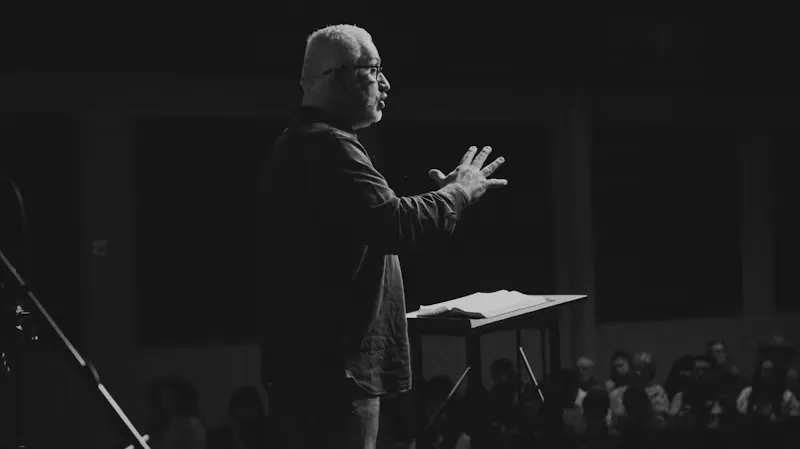
A speaker or facilitator can help create a shared starting point, focus attention on a challenge, or give a team practical language for discussing pressure and responsibility. That contribution is strongest when it is connected to what happens next. A keynote alone is not a substitute for decisions, role clarity, communication, and follow-through.
Aaron Golub’s work brings together speaking, workshops, consulting, and coaching. His lived experience as the first legally blind Division I athlete to play in a game, as a Tulane football player and team captain, informs a practical focus on adversity, leadership, and performance. Organizations can explore leadership speaking and team support as one part of a larger effort. A participant perspective can also help event planners understand how an engagement felt; see this client perspective.
When a team needs more than a single moment of shared attention, connect the session to a specific practice. A leadership event might ask participants to identify a decision that keeps getting delayed, agree on an owner, and schedule a follow-up. A workshop can include practice and reflection. Subsequent team conversations can check whether participants have applied the approach and what made it easier or harder. This link between learning and work helps keep the event grounded in the organization’s actual challenge.
When should you consider change management consulting?
Consider outside support when an important change spans multiple teams, leaders are not aligned, prior efforts have stalled, or internal owners need help structuring the work. It may also be useful when a team needs a facilitated conversation to clarify expectations and agree on next steps. A short, well-defined engagement can be appropriate when the need is narrow; broader changes may require support across diagnosis, implementation, and follow-up.
Before reaching out, write down the desired outcome, the groups affected, what is already underway, and the decisions that remain unresolved. You do not need a complete plan. A clear account of the challenge gives a prospective partner a more useful starting point and helps both sides assess fit. Note what you have tried so far and what you observed, not only what you hope a consultant will deliver.
For an initial discussion, it can help to bring a real example of where the change meets day-to-day work. Describe the situation, what each person did, where the process became unclear, and what a better result would look like. That conversation can help determine whether the next step should be diagnosis, leader alignment, a team session, coaching, or a more sustained partnership. Aaron’s background and consulting approach offer additional context for organizations evaluating fit.
Schedule a conversation about your needs
Frequently asked questions
Is change management consulting the same as project management?
They are related but distinct. Project management organizes delivery of defined work, while change management consulting focuses on how people and teams understand, adopt, and sustain new ways of working. Organizations may need both, with clear coordination between the project plan and the support people need to use the result.
How long does a consulting engagement take?
There is no single duration. Scope depends on the size and complexity of the change, the groups involved, and whether support is needed for diagnosis only or through implementation and follow-up. Agree on a useful first phase and revisit scope as the situation becomes clearer.
Does consulting mean the organization has to use a particular methodology?
No. A framework can provide structure, but it should fit the organization’s context and goals. Ask how the proposed method will translate into specific decisions, actions, and learning for your teams.
Can a workshop be part of the work?
Yes. A workshop can help people practice skills, examine assumptions, or align on next steps. It works best when its purpose is clear and leaders reinforce the learning in everyday work.
What should a first conversation cover?
Start with the outcome you need, who is affected, what is already happening, and where progress is getting stuck. A prospective partner can then discuss an appropriate first step and what information or participation would be needed to assess the situation.
Effective change support makes the next step clearer for leaders and the people doing the work. Start with the real challenge, define what better practice would look like, and build a plan your organization can learn from as it moves forward.